

Strength training for runners, explained. Why winter is the time to build it, which moves to do, how often to lift and how to time it for a spring race.
Dark evenings, cold mornings and wet pavements make winter the hardest season for long miles outside, and the best one for getting stronger indoors. The strength you build now is what you take into the lighter evenings and the spring races: the London Landmarks Half Marathon on Sunday 4 April 2027, the TCS London Marathon on Saturday 24 and Sunday 25 April (a one-off two-day Double), and the Hackney Half on Sunday 16 May.
This guide covers why winter is the season to lift, what strength work does for runners, how it helps keep you running, how often to lift, the best exercises and how to time a strength block for your race. It finishes with where to train in London, at Rumble Dalston and Rumble Fitzrovia, and what it costs.
Why winter is the time to build strength
Most spring race plans start in January or February. Count back 16 weeks from a late April marathon or 12 weeks from an April half and the running block begins just after the new year, so the weeks before it are your base. That is the window to learn the lifts, find your working weights and get two sessions a week into your routine, before the long runs take over your weekends.
Training indoors also keeps the habit going when the weather does its worst. A class booked for 7am happens whether it is raining or not, and our winter workout routine shows how to keep a full week going through the dark months. Build the strength now and you meet the spring with legs that are ready for the miles.
What strength training does for runners: the research
The clearest benefit is better running economy, which is how much energy you use to hold a given pace. Better economy means the same pace costs you less.
A 2018 review in Sports Medicine (Blagrove, Howatson and Hayes) brought together 24 studies of middle and long-distance runners, most of whom added strength training to their normal running. Of the 20 studies that measured running economy, 14 found it improved, generally by about 2 to 8% compared with runners who only ran, and in 8 of the 12 time trials the strength groups improved more than the running-only groups.
The same review found body mass unchanged in most of the studies, so the lifting didn’t make the runners heavier. The authors suggest two to three sessions a week, mixing heavy, explosive and plyometric work.
A 2016 meta-analysis in the Journal of Strength and Conditioning Research (Balsalobre-Fernández and colleagues, five studies, 93 runners) found a large effect on running economy in highly trained runners, from programmes of two to three sessions a week over 8 to 12 weeks that mixed lower-body weights with jumps and short sprints. A 2024 meta-analysis in Sports Medicine (Llanos-Lagos and colleagues, 31 studies, 652 runners) looked at which kind of lifting works. Heavy lifting, at 80% or more of the most you can lift once, improved running economy, and so did programmes that combined methods. So it pays to lift heavy enough to count.
How strength training helps prevent injuries
Strength work is one of the best-supported ways to cut injuries in sport. A review of 25 trials with 26,610 participants in the British Journal of Sports Medicine (Lauersen, Bertelsen and Andersen, 2014) found that strength training reduced sports injuries by more than two thirds, and that exercise programmes as a whole almost halved overuse injuries.
For runners, a 2024 review in Sports Medicine (Wu, Brooke-Wavell, Fong, Paquette and Blagrove) found that when the exercise sessions were supervised, injury risk was significantly lower than in the control groups. The authors linked that to compliance, people actually doing the sessions, and that is where a coached class helps: your session is in the diary and a coach is on the floor with you. If something already hurts, see a physio or your GP before you add weight.
How often should runners strength train?
The UK Chief Medical Officers’ physical activity guidelines (2019, updated in July 2026) and the NHS (page reviewed 22 May 2024) advise every adult to do muscle strengthening activity on at least two days a week, working all the major muscle groups. For runners, the 2018 review suggests two to three sessions a week.
A simple way to apply that is two strength sessions a week through the winter base and build, then one a week in the last month before your race, and nothing heavy in the final 10 days. Each session can be short, because five or six moves done well cover what a runner needs.
The best strength exercises for runners
Running is a long series of single-leg landings, so the heart of a runner’s strength session is single-leg work, backed up by a hinge, a squat, calf work and core control. Together, these six leg and core exercises make a simple gym workout for runners, and most of them need only a pair of dumbbells or a kettlebell:
Split squats and step-ups. Keep the back foot on the floor or up on a bench for a split squat, or step up onto a bench, with a dumbbell in each hand. Working one leg at a time stops your stronger side doing the work.
A hinge, such as a Romanian deadlift. Hold a kettlebell or a pair of dumbbells, push your hips back with soft knees and stand tall again. It loads the hamstrings, glutes and lower back.
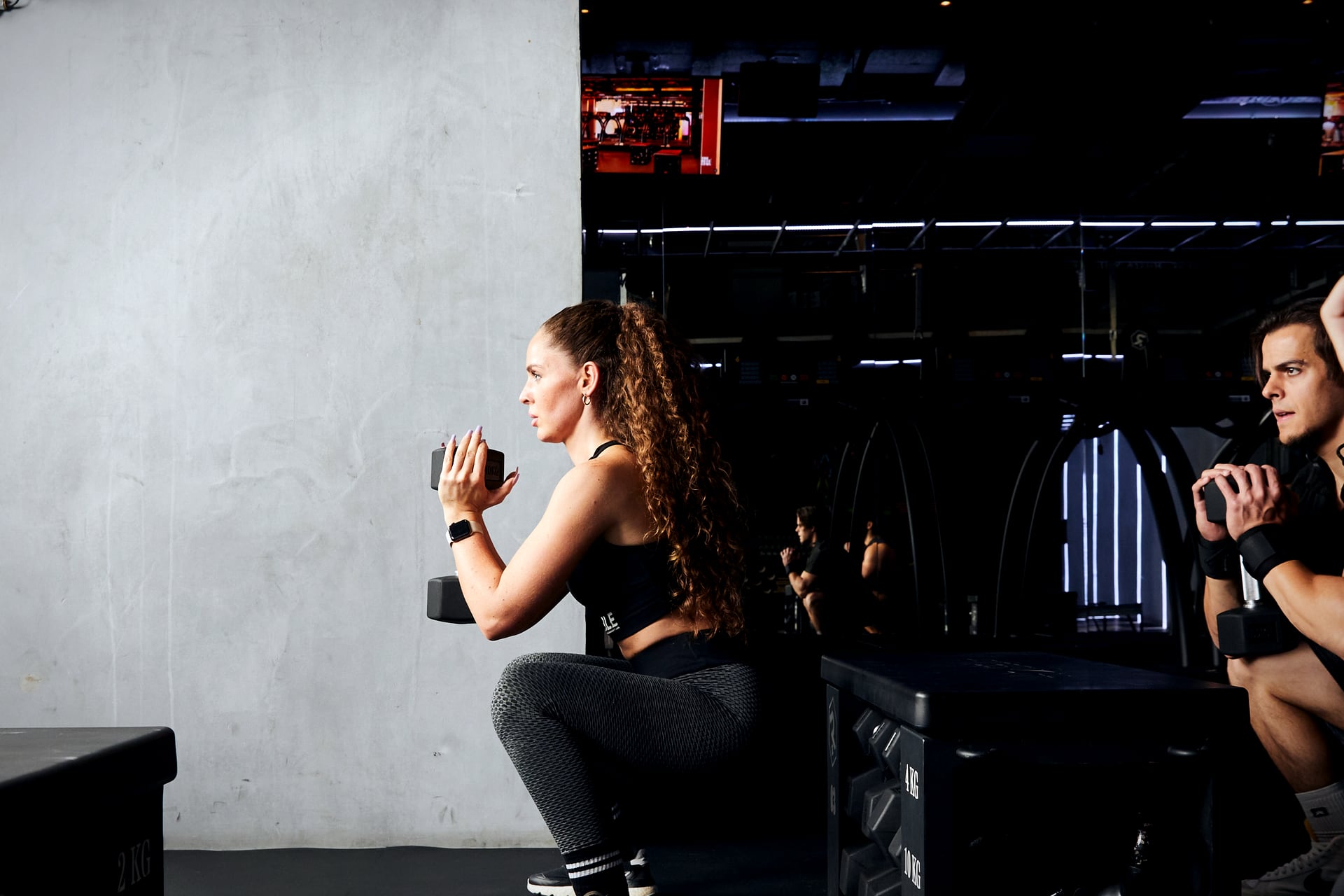
A squat, such as a goblet squat. Hold one dumbbell or kettlebell at your chest and sit down between your heels. It trains the quads and glutes together.
Calf raises. Slow raises on a step, on both legs and then one at a time, with straight knees and then bent knees so you work both calf muscles.
Core and trunk work. Planks, side planks and walking tall with a heavy dumbbell in one hand teach your trunk to stay steady while your legs move.
Hops and jumps (plyometrics), once the base is built. Skipping, pogo hops and low jumps, a few at a time with full rest. The 2018 review counted plyometric training among the methods that helped, so add them when your plan starts, once your legs are used to the lifting.
How heavy? In the research, heavy means 80% or more of the most you can lift once. A simple progression is two or three sets of 8 to 10 reps in your base weeks while you learn the moves, then three or four sets of 4 to 6 reps once your plan starts, with a weight that leaves one or two good reps in reserve. New to lifting? A coached class is the easiest start, and our guide to fitness classes for beginners explains which one to try first.

Strength training for runners before a spring race
Count your strength block back from race day. Assuming a 16-week marathon plan and a 12-week half-marathon plan, this is how the 2027 spring races fall, with the weeks before each plan as your base:
Each phase has one job:
- Base (the weeks before your plan): learn the six moves with moderate weights, two sessions a week.
- Build (plan start to four weeks out): heavier sets of 4 to 6 reps plus hops and jumps, two sessions a week, on a hard-run day or an easy day but never the day before your long run.
- Maintain (the last four weeks): one session a week, the same weights and fewer sets.
- Race window (the final 10 days): light movement only and no heavy lifting, so you start the race rested.
It’s simple on purpose, so it fits around any running plan, and if yours already sets strength sessions, follow those.
Fitting lifting around your runs
Keep hard days hard and easy days easy. The best time to lift is the same day as a hard run, a few hours later if you can, so your easy days stay easy. If your week won’t allow that, an easy-run day works too. Keep heavy leg work away from the day before your long run or a key session, and keep the long run outdoors at an easy pace.
In 21 of the 24 studies in the 2018 review, runners added strength training to their normal running rather than swapping runs for it, so lifting comes on top of your miles, not instead of them. If your legs feel heavy a day or two after your first heavy session, make the next run an easy one.
Strength built into your run: Re.Run at Rumble Dalston
If you’d rather not plan the lifting yourself, Re.Run, our run + lift class, does it for you. It’s 45 minutes of coach-programmed intervals on motorised Woodway treadmills that can be set to an incline, alternating with strength blocks at the Fitbench using dumbbells, kettlebells and slam balls. You set your own speed on every interval, so it works whether this is your first race or your tenth.
It comes in three formats, Full Body, Upper Body and Lower Body, and our guide to treadmill classes explains each one. Full Body is the usual first pick, and the live Re.Run timetable shows which format runs when, so check it for the Lower Body leg day.

Strength and conditioning on the circuit, at both studios
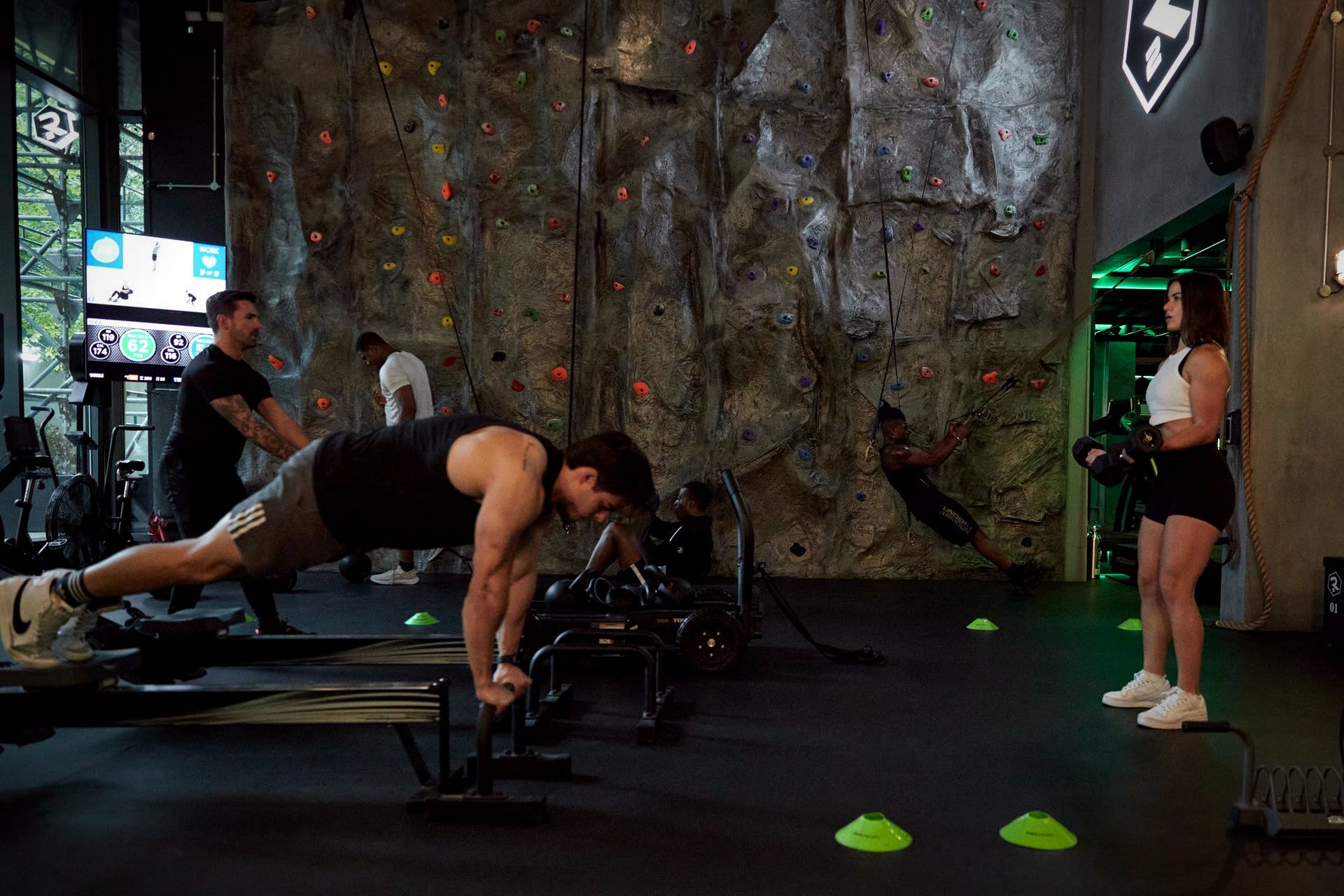
The Re.HIIT circuit runs at Rumble Dalston and Rumble Fitzrovia, and a new class starts every 10 minutes. Its Build days put the emphasis on muscular strength and its Burn days on muscular endurance, so a week on the circuit covers strength and conditioning together. Build days are Monday (upper focus), Wednesday (abs and glutes), Thursday (upper focus) and Saturday (full body), and Tuesday’s Burn day has a lower-body focus.
Of the Build days, Wednesday and Saturday carry the most hip and leg work, and Tuesday’s lower-focus Burn day adds leg endurance. If your long run is on a Sunday, make Tuesday or Wednesday your main circuit day and keep Saturday’s weights light. Screens demonstrate every move, including the warm-up, and a coach on the floor adapts each exercise to you. Walk in and a coach will get you going within 10 minutes, and at peak times, such as before work, at lunchtime and after work, book your start.
What it costs (as of November 2026)
New to Rumble? Start with the Discover offer, three classes of your choice for £45, for new clients only, booked within one month and valid at either studio. Try a Re.Run class, a Build-day circuit and one more class, then choose. After that, unlimited memberships start from £49 a month:
Prices can change, so the memberships page always has the current list. And for one social run a week through the winter, join Rumble Run Club, a 30-minute group run from Rumble Dalston.
Strength training for runners: quick answers
Winter is when runners get strong. If you’re new to Rumble, start with the £45 Discover offer, three classes of your choice at either studio. Book your first class, tell the coach which race you’re training for, and build from there, so you meet the spring ready to run.
More from the R2 Journal



Join our newsletter
Training tips, recipes and stories from the studios — straight to your inbox.